Elite sport is often decided by small margins: a few seconds, a single point, a final burst of energy, or the ability to maintain concentration when the body is exhausted. At the highest level, these small differences can separate an outstanding athlete from everyone else.
The story of Novak Djokovic provides an interesting insight into what can happen when nutrition becomes part of an athlete’s overall performance strategy.
Before 2010, Djokovic had already established himself as a Grand Slam champion, but he experienced physical difficulties during matches, including fatigue and difficulty maintaining his performance. During the 2010 Davis Cup in Croatia, he met Serbian nutritionist Dr Igor Cetojevic. According to Djokovic and profiles published by Olympics.com, this encounter became an important turning point in his approach to nutrition.
Djokovic subsequently experimented with removing gluten from his diet and reported improvements in how he felt and performed. Over time, his approach to food became more structured, alongside his training, recovery, yoga, and meditation practices.
The important lesson for athletes is not simply that Djokovic stopped eating gluten.
It is that nutrition became an intentional part of his performance preparation.
The Dietary Turning Point That Changed Djokovic’s Approach
Djokovic has described experiencing changes in his energy and physical condition after removing gluten from his diet under Dr Cetojevic’s guidance. He later tested his response by eating a bagel after a period without gluten and reported feeling fatigued.
Following these experiences, he continued with a predominantly gluten-free dietary pattern.
In 2011, Djokovic had one of the most remarkable seasons of his career, winning three of the four Grand Slam tournaments. In his book Serve to Win, he described his dietary changes as an important factor in the transformation he experienced.
However, there is an important nutritional distinction to make.
Djokovic’s experience with gluten should not be interpreted as evidence that every athlete will benefit from eliminating gluten.
For people with coeliac disease, avoiding gluten is medically necessary. Some individuals may also experience specific sensitivities or other reasons for choosing a gluten-free diet. But for athletes without a medical or individual reason to avoid gluten, removing it does not automatically improve athletic performance.
This is where the philosophy behind sports nutrition, including the approach followed by Qua Nutrition under sports nutrition expert Ryan Fernando, becomes important.
The lesson is not that athletes should go gluten-free to become better performers.
The lesson is to understand what works for your own body, sport and performance demands.
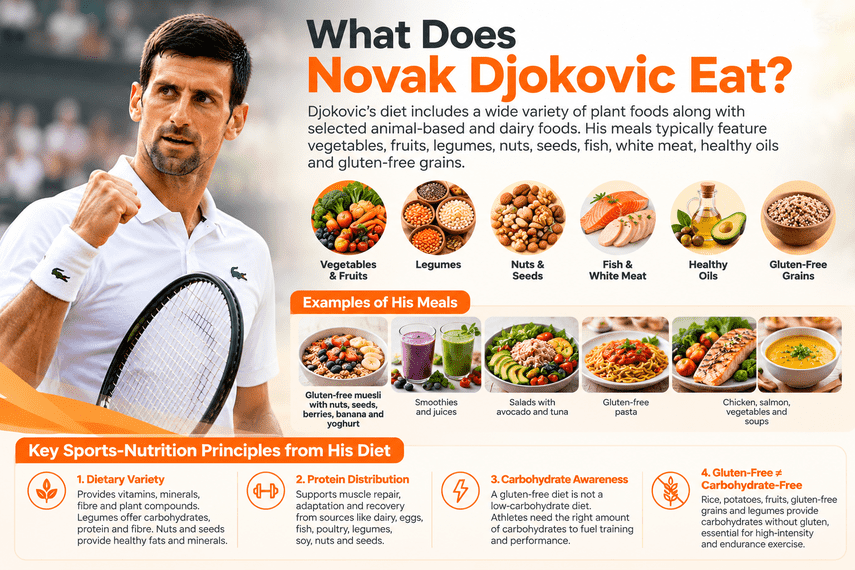
What Does Novak Djokovic Eat
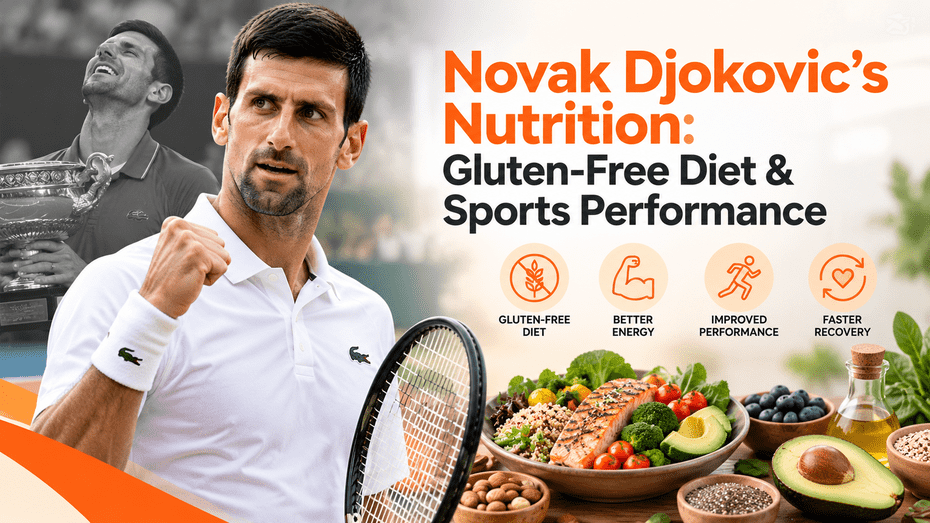
Djokovic’s reported dietary pattern has generally included a wide variety of plant foods alongside selected animal-based and dairy foods. His diet has been described as including vegetables, fruits, legumes, nuts, seeds, fish, white meat, healthy oils and gluten-free grains.
Reported meals have included gluten-free muesli with nuts, seeds, berries, banana and yoghurt, along with smoothies and juices. Other meals associated with his dietary pattern include salads, avocado, tuna, gluten-free pasta, chicken, salmon, vegetables and soups.
Looking beyond the celebrity name, several useful sports-nutrition principles can be identified.
- First is dietary variety: Vegetables and fruits provide vitamins, minerals, fibre and a wide range of plant compounds. Legumes such as chickpeas and lentils provide carbohydrates, protein and fibre. Nuts and seeds contribute healthy fats, minerals and other nutrients, while fish can provide high-quality protein and omega-3 fatty acids.
- Second is protein distribution: Protein is essential for muscle repair, adaptation and recovery. Rather than relying on one particular food, athletes can obtain protein from dairy, eggs, fish, poultry, legumes, soy products, nuts and seeds depending on their dietary preferences and requirements.
- Third is carbohydrate awareness: Although Djokovic’s diet is often discussed in the context of gluten avoidance, it should not be confused with a low-carbohydrate diet.
- Gluten-free does not mean carbohydrate-free: Rice, potatoes, fruits, gluten-free grains, legumes and many other foods can provide carbohydrates without containing gluten. For athletes, carbohydrates remain an important source of fuel, particularly during high-intensity training and endurance exercise.
Sports nutrition should therefore focus on getting the right amount of carbohydrates at the right time rather than unnecessarily eliminating an entire nutrient group.
What Athletes Can Learn From Djokovic’s Nutrition Strategy
Perhaps the biggest lesson from Djokovic’s experience is that sports nutrition is highly individualised.
An athlete’s nutrition strategy should consider the type of sport, training volume, competition schedule, body composition goals, food preferences, digestive tolerance and relevant medical considerations.
An endurance runner may require substantial carbohydrate availability before a long training session. A strength athlete may benefit from adequate protein distributed throughout the day. A cricketer may need strategies that account for long periods of competition, travel, and irregular match schedules.
There is no single “athlete’s plate.”
However, there are several principles that can apply across different sports.
Fuel the work: Nutrition should provide enough energy to support training and competition rather than simply focusing on calorie restriction.
Prioritise protein: Adequate protein intake, distributed appropriately throughout the day, supports muscle repair and adaptation.
Use carbohydrates strategically: Carbohydrates can fuel high-intensity and endurance exercise while helping replenish muscle glycogen.
Include healthy fats: Nuts, seeds, fish, avocado, and appropriate oils can provide energy and important nutrients.
Eat a variety of plants: A diverse selection of fruits, vegetables, legumes, nuts and seeds can help provide a broad range of nutrients.
Respect food tolerance: Athletes should pay attention to how different foods affect digestion, particularly around training and competition.
Hydrate appropriately: Fluid and electrolyte requirements vary according to exercise duration, sweat losses, environmental conditions and individual needs.
Do not copy a champion blindly: Djokovic’s nutritional strategy was developed around his own body, sport, and circumstances. A diet suitable for a Grand Slam tennis player may not be appropriate for a recreational runner or someone training at the gym.
This personalized philosophy is central to the approach of Qua Nutrition. Instead of simply asking, “What does a champion eat?”, the more useful question is, “What does this athlete need?”
From Champion’s Diet to Your Performance Plan by Qua Nutrition’s team
One of the most interesting aspects of Djokovic’s journey is that nutrition was not treated as an isolated intervention.
His approach has also involved training, recovery, sleep, yoga, meditation, and mental preparation. Performance is therefore better understood as a complete system rather than the result of one food or supplement.
This is an important lesson for athletes at every level.
You cannot build better performance simply by focusing on what you eat. However, inadequate nutrition can make it harder to train effectively, recover properly, and maintain performance consistently.
At Qua Nutrition, our sports-nutrition approach reflects this broader perspective.
Whether you are a professional athlete, competitive runner, gym enthusiast or someone preparing for your first major sporting event, nutrition should be designed around your individual requirements.
A performance-focused plan may consider pre-workout nutrition, post-workout recovery, daily protein distribution, carbohydrate timing, hydration, competition-day fuelling and practical meals that fit your lifestyle.
The goal is not to make you eat like Novak Djokovic.
The goal is to help you understand why his nutrition strategy works for him and then identify what can work for you.
How Qua Nutrition and Ryan Fernando Can Help
At Qua Nutrition, founded by sports nutrition experts like our Founder, Ryan Fernando, the focus is on helping athletes build nutrition strategies around their individual bodies, sports, and ambitions.
The objective is not to copy the diet of a celebrity athlete. It is to understand your training demands and create a practical strategy that supports performance.
This may include learning what to eat before training, how to recover after exercise, how to fuel during competition, how to distribute protein and carbohydrates, and how to make your nutrition plan sustainable throughout the season.
Your goal could be completing your first 5K, preparing for a marathon, improving strength and fitness, competing at the state level or pursuing elite athletic performance.
Whatever the goal, nutrition can become part of the preparation rather than an afterthought.
The next champion does not need to eat exactly like Novak Djokovic.
They need to discover what helps their own body perform at its best.
Train with purpose. Fuel intelligently. Recover with intention.
Your performance journey could begin with the next meal you eat.
Let Qua Nutrition help you build a nutrition strategy designed around your goal.
Conclusion: What Djokovic’s Journey Really Teaches Us
Novak Djokovic’s shift towards a gluten-free diet is often remembered as the change that transformed his career. But the deeper lesson is more nuanced.
His experience highlights the importance of paying attention to how nutrition affects performance, understanding individual food requirements, and maintaining consistency over time.
A gluten-free diet is not a shortcut to athletic success.
A smoothie is not a shortcut.
A superfood is not a shortcut.
And a supplement is not a substitute for the fundamentals.
Champions are built through thousands of consistent decisions: training with purpose, eating enough, recovering properly, staying hydrated, sleeping adequately, and adjusting when something is not working.
This is where personalised sports nutrition can make a meaningful difference.
Frequently Asked Questions
1. Is Novak Djokovic on a gluten-free diet?
Novak Djokovic has followed a predominantly gluten-free dietary pattern and has publicly discussed removing gluten from his diet. However, his experience should not be considered evidence that every athlete needs to avoid gluten. Dietary choices should be based on individual health, tolerance, nutritional requirements and professional guidance.
2. Why did Novak Djokovic remove gluten from his diet?
Djokovic has described experiencing physical and energy-related changes after eliminating gluten from his diet. He has credited this dietary change as part of his broader approach to nutrition and performance. However, individual responses to foods can vary considerably.
3. Does a gluten-free diet improve sports performance?
Not necessarily. A gluten-free diet can be essential for people with coeliac disease and may be appropriate for some individuals for other reasons. For athletes without a medical or individual reason to avoid gluten, there is no need to eliminate it simply to improve performance. Overall energy, carbohydrate availability, protein intake, hydration and recovery are generally more important factors.
4. What foods are included in Novak Djokovic’s diet?
Reported foods associated with Djokovic’s dietary pattern include vegetables, fruits, legumes, nuts, seeds, fish, white meat, healthy oils, gluten-free grains and selected dairy foods. His meals have also been reported to include smoothies, salads, gluten-free pasta, soups and other nutrient-dense foods.
5. Is Novak Djokovic’s diet suitable for every athlete?
No. A professional tennis player’s nutrition requirements can be very different from those of a runner, swimmer, footballer, strength athlete or recreational gym-goer. Nutrition should consider training intensity, sport, body composition goals, competition schedule, food tolerance and individual preferences.
6. Does gluten-free mean carbohydrate-free?
No. Gluten-free and carbohydrate-free are completely different concepts. Foods such as rice, potatoes, fruits, legumes and many gluten-free grains contain carbohydrates without containing gluten. Athletes often need adequate carbohydrates to support high-intensity training, endurance exercise and recovery.
7. What can athletes learn from Novak Djokovic’s nutrition strategy?
The biggest lesson is individualisation. Instead of copying a champion’s diet, athletes should understand their own energy, protein, carbohydrate, hydration and recovery requirements. A personalised sports nutrition plan can help align food choices with training and competition demands.
Conclusion: What Djokovic’s Nutrition Journey Really Teaches Us
Novak Djokovic’s nutrition journey is often associated with his decision to follow a gluten-free diet. But the broader lesson goes beyond gluten.
His experience highlights the importance of understanding how nutrition fits into an athlete’s complete performance strategy. Food choices, training, recovery, hydration, sleep and mental preparation all contribute to an athlete’s ability to perform consistently.
A gluten-free diet is not a shortcut to athletic success. Nor are individual foods, supplements or popular nutrition trends. What matters is whether an athlete is meeting their nutritional requirements consistently and choosing a strategy that works for their own body and sporting demands.
For athletes, the better question is not “What does Novak Djokovic eat?” but “What does my body need to perform at its best?”
At QUA Nutrition, sports nutrition is approached around the individual athlete, their sport, training demands and performance goals. Whether you are preparing for your first competition or working towards elite-level performance, a personalised nutrition strategy can help you fuel training, support recovery and make your nutrition more sustainable.
Train with purpose. Fuel intelligently. Recover with intention.
Your nutrition should not be about copying a champion. It should be about discovering what helps you perform at your best.